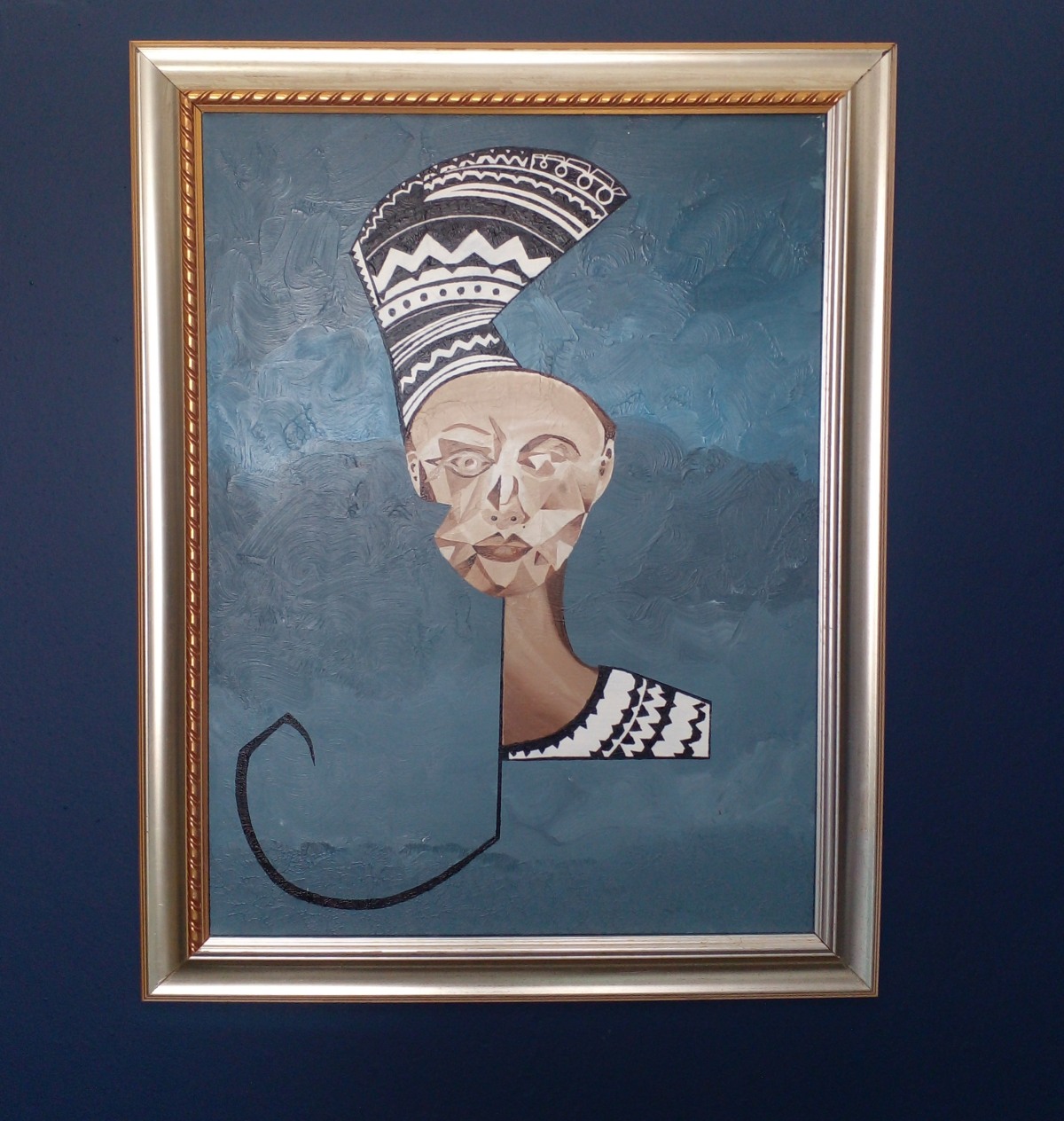
Makoti
The Defining Pan-African Masterpiece
Jump to:
A Celebration of Women
There is a painting that stares back at you.
Not in the way the Mona Lisa does; that famous, elusive smile that has launched a thousand scholarly careers and a million tourist selfies. No, Makoti stares back with something far more unsettling: recognition.
She knows you see her. And she knows you don't fully understand what you're looking at.
Makoti—meaning "Bride" in Xhosa and Zulu—is first and foremost a celebration of the women of Africa and the African diaspora. But it is also a celebration of women everywhere.
She is simultaneously a bride and a Sangoma (traditional healer). The bride represents new beginnings, hope, the continuation of lineage and culture. The healer represents wisdom, ancient knowledge, the power to mend what is broken, both body and spirit.
In her, we see the fullness of womanhood: the joy of new life, the weight of ancestral wisdom, the strength to heal a continent.
She wears a crown echoing Queen Nefertiti's, a nod to North African royalty and the continuity of African civilization. Her features are a composite of ancestral faces, a digital mosaic of the many women who came before. This is not one woman. It is all women.
Setting the Record Straight
For centuries, Western colonial narratives deliberately distorted the role of the Sangoma, framing her as a "witch doctor", a term dripping with derision and intended to delegitimize African spiritual practices.
The reality is radically different.
A Sangoma is a healer, a mediator between the physical and spiritual worlds, a custodian of ancestral wisdom, a counselor, and a community leader. She heals the sick, resolves disputes, guides the lost, and preserves cultural memory. She is revered, not feared.
Makoti sets the record straight.
In her, we see the true Sangoma: a woman of immense power, wisdom, and dignity. Not a figure of superstition, but a figure of truth. Not a relic of the past, but a guide for the future.
How Makoti Was Made
The creation of Makoti is itself a story of patience, vision, and intention.
The Digital Composite
The artist began by collecting countless images of women: photographs, portraits, everyday snapshots. These were women from across Africa and the diaspora, women of every age, every background, every walk of life.
He layered them, one on top of another, in a digital collage. He filtered, adjusted, and refined until a single face began to emerge from the collective.
This was the face he was searching for: the perfect woman.
Not "perfect" in the Western sense; flawless skin, symmetrical features, impossible proportions. No. Perfect in the African sense: a face that could represent all women.
Africa is diverse. Its people are a tapestry of cultures, ethnicities, and histories, including the stories of people who settled in Africa from other parts of the world. They all collectively form the fabric of society. Makoti includes them all.
The Pen-on-Paper Drawing
Once the digital prototype was complete, the artist did something unusual.
He sketched Makoti in pen on paper. Every line was deliberate, every curve intentional. This was not a mechanical reproduction of the digital image but a translation, from pixels to ink, from screen to hand.
Then, he deleted all the digital files.
The Public Debut
The pen-on-paper drawing made its public debut at the artist's exhibition, "True Pan-Africanism: A Look into the Future of Africa," in 2022 at the Nelson Mandela Metropolitan Art Museum in Gqeberha.
This was the moment Makoti first met the world.
The Painting
After the exhibition, the artist returned to the drawing. He picked up his brushes and paints and transferred the image from paper to canvas, from black and white to color, from sketch to masterpiece.
The painting of Makoti made its public debut at the artist's exhibition, "How It's Done: Art That Changes the World," in 2023 at The Tramways Building in Nelson Mandela Bay.
This was the moment Makoti became what she is today: a museum-quality Pan-African masterwork of global historical significance.
A Reminder to Men
The artist did not create Makoti as an abstract exercise in beauty. He created her as a reminder.
A reminder to men about the importance of women in society. A reminder that women are to be respected, honored, protected, and valued.
This is not a sentimental message. It is a desperate, urgent plea.
Gender-Based Violence and Femicide
In South Africa, a woman is killed every few hours. The statistics are staggering, and they have been staggering for decades. Gender-Based Violence and femicide are a national crisis, a crisis that the artist confronts directly through his work.
Makoti is not a passive painting. She confronts.
She confronts the systems that allow this violence to continue. She confronts the silence that enables it. She confronts the cultural norms that excuse it.
Women in Times of War and Conflict
History has shown us that women are disproportionately victimized in times of war and conflict. They are targeted, violated, and erased. Their suffering is often invisible, drowned out by the noise of battle and politics.
Makoti refuses to let this continue. She stands as a witness, a protector, and a voice for the voiceless.
Makoti vs. The Western Canon
The Western art canon is built on a handful of iconic images: the Mona Lisa, the Venus di Milo, the Statue of Liberty. These are powerful images, no doubt. But they are also incomplete.
They represent a narrow vision of beauty, power, and meaning, one that excludes Africa, excludes women of color, and excludes the stories that have shaped the majority of humanity.
Makoti is more powerful.
Not because she is technically superior (though she is). Not because she is more beautiful (though she is). But because she has a greater story.
| Icon | The Story It Tells |
|---|---|
| Mona Lisa | A portrait of a wealthy woman, famous for her mysterious smile |
| Venus di Milo | A Greek goddess, armless, frozen in time |
| Statue of Liberty | A symbol of freedom; for some people, in some places |
| Makoti | A celebration of all women, a healer, a protector, a reminder of what we owe to women, and a demand for justice, representation, and healing |
Beauty Standards and Representation
The Western canon has defined beauty standards for centuries. These standards are narrow, exclusive, and often harmful.
Makoti challenges all of this.
She declares: This is beauty. Not in spite of my African features, but because of them. Not despite my heritage, but because of it.
She declares: Representation is not optional. It is essential. When we see ourselves in art, we see our worth. When we are erased, we are diminished.
Ubuntu, Pan-Africanism, and the Power of Women
Ubuntu
Makoti is built on the philosophy of Ubuntu, the belief that our humanity is intertwined with the humanity of others.
She is a bridge between North and South Africa, between Arab and Black, between tradition and modernity. She synthesizes Northern and Southern African excellence, blending traditional Southern African cultural signifiers with iconic North African royal silhouettes echoing Queen Nefertiti's crown.
She offers healing. She offers unity.
Pan-Africanism
Makoti is a Pan-African symbol. She represents the continent as a unified whole, not a collection of warring nations or competing ethnic groups.
The artist's vision is one of cultural convergence and mutual respect. In Makoti, an Arab man and a black African woman sit face to face, poised between reflection and connection. Their garments weave together patterns inspired by both African and Arab design, symbolizing the unity that is possible when we look beyond our differences.
The Power of Women to Unite the World
Farook Mohammed believes that women have the power to unite the world.
Not because they are passive or weak. But because they are strong, resilient, and essential.
Women are the foundation of everything: families, communities, nations, and the future. When we honor them, we honor ourselves. When we protect them, we protect our future.
Makoti is a testament to this truth. She is a living, breathing symbol of what we can achieve when we embrace the power of women and the wisdom of our ancestors.
Why Makoti Has a Greater Story
| Element | Makoti | Mona Lisa | Venus di Milo | Statue of Liberty |
|---|---|---|---|---|
| Purpose | Celebrate women, heal a continent | Portrait | Religious idol | Symbol of freedom |
| Message | Unity, Ubuntu, justice | Mystery | Classical beauty | Liberty |
| Relevance | 21st century, global | 16th century, European | Ancient Greece | 19th century, Western |
| Representation | African women, all women | European woman | Greek goddess | European-American woman |
| Healing | Confronts GBV, femicide, trauma | None | None | None |
Makoti does more than the Mona Lisa. She heals. She unites. She confronts injustice.
A Protected Cultural Heritage Asset
Makoti is not merely a painting; it is a culturally significant heritage and tourism asset of Nelson Mandela Bay, South Africa. It belongs to the people of the city, and its preservation is a matter of collective responsibility.
Shared Among Museums and Universities
Makoti will be shared among museums and universities worldwide as part of a carefully managed program of cultural exchange and education. The artwork will be made available for exhibition, study, and scholarly research at institutions that demonstrate a commitment to the values it represents: Ubuntu, Pan-Africanism, and the celebration of women.
Conditions for Physical Loans
The physical artwork is highly revered and protected. Any loan or touring exhibition of the original canvas will be subject to strict guidelines befitting a high-profile cultural asset. These conditions include:
- Security and environmental standards that meet or exceed international museum benchmarks.
- Insurance coverage commensurate with the artwork's cultural and financial value.
- Limited duration and controlled transport to minimize risk.
- Collaborative agreements with host institutions to ensure the artwork's message is presented accurately and respectfully.
Digital Exhibitions
In cases where there is a risk of damage to the physical artwork, due to transport, environmental conditions, or other factors, digital exhibitions only will be permitted. High-resolution reproductions, interactive displays, and virtual reality experiences will allow audiences worldwide to engage with Makoti without compromising its safety.
A Legacy for Future Generations
Makoti is preserved for future generations. Its presence in Nelson Mandela Bay serves as a beacon of hope, unity, and cultural pride. Its sharing with the world is a testament to the city's commitment to global cultural dialogue and the recognition of African art as a vital part of humanity's shared heritage.
Why You Need to Experience Makoti
To stand before Makoti is to witness history in the making. This is not merely a painting; it is a living, breathing testament to the resilience, beauty and unity of the African continent.
Under shifting light, the portrait transforms, revealing new dimensions with every glance. The kinetic gaze illusion invites you into an intimate dialogue with the subject, a celebration of womanhood, spirituality and ancestral power that transcends time and geography.
Whether you are an art lover, a historian or a traveller seeking meaning, Makoti offers an experience that will move you, challenge you and leave you forever changed. This is the defining Pan-African masterpiece of our time, and it belongs to Nelson Mandela Bay.
→ Plan your visit to Nelson Mandela Bay
Share This Story
If this story moved you, please share it. Makoti deserves to be seen. She represents something far larger than any one painting or any one artist.
She represents a future where art truly belongs to everyone.
Where the canon is not a gate but a garden.
Where representation is not a concession but a celebration.
Where the women of Africa, and the women of the world, are recognized for what they have always been: the foundation of everything.
🏆 Awards & Recognition:
Most Influential People of African Descent (MIPAD 100) — Global Top 100 Honoree, Afrofuturism & Creative Category (Class of 2024)
Mzansi Arts & Media Award (MAMA) — Best Exhibition Events Organizer (2021)
Inspirational Art Magazine Issue 102 — Comparative Case Study: Makoti vs. Mona Lisa, Venus di Milo, Statue of Liberty, and Queen Nefertiti
About the Artist
Farook Mohammed is a visual artist and Pan-Africanist born and raised in Gqeberha, Nelson Mandela Bay, South Africa. His work is deeply rooted in the philosophy of Ubuntu, the belief that our humanity is intertwined with the humanity of others.
"My work is deeply rooted in storytelling, capturing moments where history, spirituality and identity converge. For me, art is not only expression; it is documentation. It is how I preserve truth and reinterpret the world through an African lens."
Through his art, Mohammed explores themes of African cultural heritage, Afrofuturism, decolonial aesthetics and the spiritual power of African womanhood. His works serve as bridges between Northern and Southern African traditions, challenging colonial narratives and asserting a bold new vision for the continent.
Mohammed has been recognized globally as a MIPAD 100 Global Top 100 Honoree in the Afrofuturism & Creative Category (Class of 2024) and received the Mzansi Arts & Media Award (MAMA) for Best Exhibition Events Organizer in 2021. His work has been featured in Inspirational Art Magazine, Imbizo Magazine, Art & Wine Magazine, and The New Arab, and he has been interviewed on the Considering Art Podcast (UK) and Warfare of Art and Law Podcast (USA).
© 2026 Farook Mohammed. All rights reserved.
Makoti belongs to Nelson Mandela Bay. The artist is merely the interim custodian.